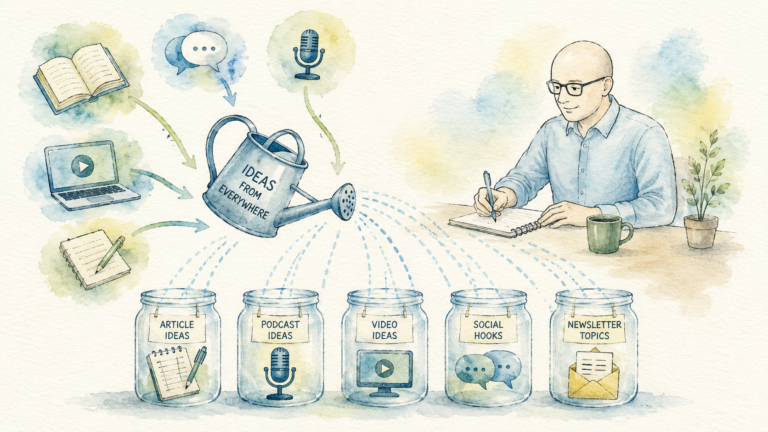
You have heard me implore agencies to get on board with AI more quickly and more aggressively.
Part of that is staying plugged in to the latest developments that help you do so effectively.
I’m experimenting with a new concept called SAGA Signals that provides agency owners with a briefing on the latest AI news and insights.
I’m including the first version later in this week’s newsletter.
I need your help by giving me feedback.
Let me know what you think about the concept and whether you would like to see it included in the newsletter going forward — and whether you would like to see it instead of or in addition to a deeper dive from me on a specific topic. (I would move my topical commentary to articles and still feature them in the “Latest from SAGA” section.)
So read on and then share your thoughts.
— Chip Griffin, SAGA Founder
Latest from SAGA
BUILD TO OWN, NOT MAYBE SOMEDAY. A lot of agency owners have internalized the wrong lesson from Built to Sell: spending years optimizing for a buyer that may never show up, while the business they own isn’t working for them today. In the latest Agency Leadership Podcast episode, Gini and I dig into the Build to Own philosophy and what it actually means to design your agency around your own Time, Meaning, Rewards, and Work (TMRW), not some Maybe Someday exit scenario.
COUNT YOUR FINGERS. If you run out before you run out of direct reports, you already know the problem. Most agency owners end up managing far too many people directly — not by design, but because adding structure always feels premature. I wrote about the one hand rule and why five direct reports is roughly the limit at which proper management remains possible. Past that, the weekly 1:1s are the first thing to go and everything else follows.
CHEAP AI WON’T LAST. Current pricing reflects a land-grab moment, not a sustainable business model. If cost savings are the primary value you’re extracting from AI right now, that’s a fragile strategy. The first SAGA Signals AI briefing covers what’s actually worth your attention, including why the agent era is closer than most agency owners realize and what you should be building now regardless of which tools you’re using.
Jen’s Weekly Roundup
Everything is changing and at the same time nothing is changing. Social media platforms shift, leadership practices evolve, economic conditions flex, but the sometimes ridiculous problems agencies face? Those never go away. This week’s content wrestles with that paradox: how do you build for a moving target when half the fundamentals stay stubbornly constant?
WHAT CAUGHT OUR EYE THIS WEEK:
CHANGE VERSUS CONSTANTS — RSW/US reminds us that even the ridiculous never changes—agencies still make the same baffling mistakes decade after decade. Spin Sucks reinforces this with knowing history strengthens your communications strategy, arguing that context and patterns matter more than chasing whatever’s new. But then For Immediate Release examines social media’s big shift and Anchor Advisors explores an inquiry into the shifting practice of leadership. So which is it—everything changes or nothing does? Yes. Or as Chip and Gini always say, it depends.
SYSTEMS THAT FLEX — The answer to that paradox showed up twice: build systems that can handle change without breaking. Agency Bytes features David Wain-Heapy on why remote-ready agencies win with systems before scale. You can’t scale chaos, and you can’t pivot without structure. David C. Baker at Punctuation examines employment law and economic flexibility, showing how legal structures can enable or constrain your ability to adapt when conditions shift.
GROWTH PATHS AND OPTIONALITY — Gould + Partners explores reasons why a PR firm might turn to an acquisition, examining when buying becomes a more strategic path than building organically. It’s about creating options when your current trajectory isn’t getting you where you need to go—or getting you there fast enough. Combined with Baker’s piece on economic flexibility, the message is clear: the strongest agencies maintain multiple viable paths forward.
THE PESO MODEL’S MOMENT — Spin Sucks makes the case that the PESO Model was built for this moment. When platforms shift, algorithms change, and channels rise and fall, having an integrated framework that works across paid, earned, shared, and owned media means you’re not dependent on any single tactic staying stable. It’s a practical example of building for change while maintaining strategic coherence.
KNOW YOUR NUMBERS — The Innovative Agency features Jody Grunden on your agency by the numbers this year, cutting through the narrative stories agencies tell themselves to focus on what the financial data actually reveals. Because you can’t make smart decisions about growth paths—organic or through acquisition—if you don’t know where you actually stand.
THE BOTTOM LINE — The agencies that thrive aren’t the ones that predict the future perfectly or resist change. They’re the ones that built systems flexible enough to adapt when conditions shift, maintained multiple growth options, and stayed grounded in the fundamentals: know your numbers, learn from history, and put structure in place before you need it.
— Jen Griffin, SAGA Community Manager
SAGA Signals: Cheap AI won’t last, but the agent era is already here
SAGA Signals is a briefing with AI news and insights for agency owners.
There’s a consistent thread running through the latest AI news: the gap between what agency owners think AI is doing for (or to) their businesses and what’s actually happening. The research is getting more rigorous, the capabilities are accelerating faster than most realize, and practical tools are multiplying.
Here’s a look at what’s worth your attention.
CHEAP AI WON’T LAST. Axios offers a useful reality check: don’t build your agency’s AI strategy around cost savings. Current pricing reflects a land-grab moment, not a sustainable business model. If the only value you’re extracting from AI is reducing your current labor costs, you’re setting yourself up for a rude awakening when pricing normalizes (and your usage increases). Focus on value, not short-term (and short-sighted) margin improvement.
THE ANTHROPIC LABOR STUDY. Anthropic released one of the more careful analyses yet of how AI is affecting job functions, mapping capability by category alongside actual adoption rates. It’s worth your time if you want a grounded picture of where AI is and isn’t displacing real work. But The Algorithmic Bridge spotted something worth reading alongside it: a significant gap the report accidentally exposes about how the industry accounts for certain kinds of judgment-heavy work. Read both together because there’s truth in each.
MARKETING IS WINNING THE AI REVENUE RACE. Stanford’s AI Index found that 71% of respondents using AI in marketing and sales report revenue gains — the highest of any business function surveyed.
WHAT “BIGGER THAN YOU THINK” ACTUALLY MEANS. One of the underappreciated shifts right now: AI isn’t just pulling time away from traditional search. People are spending more total time searching for answers, not less. For agencies doing content and communications work, that’s worth noting.
THE MANAGER’S NEW JOB. Many agencies already struggle with developing the skills of managers at all levels. That makes this thread worth thinking about: AI is now a fundamental management skill, and it’s every manager’s responsibility to show their team how to use it effectively. That’s not a technology question. It’s an urgent leadership question.
PROMPTS ARE PORTABLE. PLATFORMS AREN’T. SaaStr offers a smart frame for thinking about the AI agent landscape: don’t over-invest in any single platform or model. A wave of platform churn is coming as capabilities shift and pricing changes. What you can take with you are your processes and your prompt libraries. Build those now, regardless of which tools you’re using today.
THE AGENT ERA IS CLOSER THAN YOU REALIZE. Perplexity just announced Computer, an AI agent that assigns work to other AI agents. The one-to-one chatbot interaction you’re still getting comfortable with is already starting to look like the early web. This isn’t a reason to panic. It is a reason to stay curious and keep experimenting rather than locking into any single workflow.
NEED A STARTING POINT? If you’re still figuring out how to put AI to work at your agency, two practical pieces are worth bookmarking this week. This overview of AI in digital marketing is solid for brainstorming, and this roundup of marketing AI agents gives you a concrete look at what tools exist and what they’re actually good for. Absorb these kinds of articles regularly to fuel your thinking and get inspiration.
THE BOTTOM LINE. The agencies that will get the most from AI aren’t the ones chasing the newest tool or cutting the most cost. They’re the ones building sustainable processes, developing real internal expertise, and treating AI adoption as an organizational responsibility rather than an IT project.
TELL ME WHAT YOU THINK.
- How would you improve the SAGA Signals content?
- Should the newsletter include the full SAGA Signals briefing or should the email link to the full text on our website?
- Should SAGA Signals replace my topical commentary each week (and move that commentary to standalone articles)?
Visit the SAGA Contact page to send us your feedback.